Sunday, 30 October 2011

Are soaps dumbing down or do they reflect social realism?

Some people would agree that soaps are 'dumbing down' and are 'jump TV' but on the other hand some would disagree.
  • Because soaps are not seen as intellectual programs.
  • Soaps have numbers of incidents and issues that occur to a certain group of people.
  • Soaps encourage to see life in very simple, black and white ways.
  • The tabloid press focus so heavily on events in soaps that people lose sight of the distinction between reality and television, characters and actors/actresses. 
However:
  • Soaps reflect the society in which we live and encourage us to reflect on our own lives and attitudes.
  • Soaps are hugely popular because they are relevant to the lives of the audience.
  • Soaps reflect social issues in a topical, challenging and responsible way, maintaining a balance between drama and realism.
  • Soaps depict ordinary people, different genders, and people from different ethnic backgrounds in positive ways.

Friday, 28 October 2011

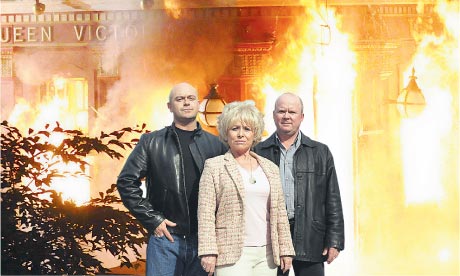
How does this extract from Eastenders demonstrate soap conventions?

  • Location - Characters houses where the scene is set, popular place, social places where characters meet and mingle, for example, The Queen Vic or The Cafe in Eastenders.
  • Camerawork - Mostly mid-shots.
  • Editing - Only uses mainly hard cuts throughout.
  • Lighting, naturalistic, high key - Inside (characters houses/pubs etc) and outside (the market)
  • Sound - Diagetic apart from the theme tune at the beginning and end.
  • Character representation - Stereotypes, typical teenager, skiving school., fights. Young parents, single parent trying to do the best for their son/daughter. Typical families. Real life stories - alcoholics, aggressive family member(s) etc.

Sunday, 16 October 2011

Typical characters.

There are many stereotypical characters in a soap or issues. Some people can relate to these issues and character. There are many, such as:
  • Young/single mum.
  • Alcoholic/druggy.
  • Violent person, the 'tough' man.
  • The boss
  • The strong women.
  • Pregnant teen.
  • Abused character.
  • Poor/no education, skips school.
  • Life problem e.g cancer.
  • Divorced couple.
  • Ethnic issues, different background, race etc.
  • Young couple.
  • 'lesbian/gay' couple.
  • Old people
  • Christian (usually an old person)
  • Struggling family. (low classed)
  • Affairs.
  • Dumb blonde(s).


Tuesday, 11 October 2011

Soap Research.

Eastenders.
Eastenders has had the same theme tune for the past 25 years. The drum beat at the beginning of the theme tune is the start of the interpellation; the audience recognise this tune as Eastenders. There is a picture of the Thames which is typical iconography of London. The theme tune repeats itself (almost as if it is on a loop) and it is very simple and easy to remember. It almost sounds like an orchestral piece and therefore sounds old-fashioned, perhaps representing the soap's long running history. The writing of 'EastEnders' is a serif font which looks casual and traditional; catching the audience's eye. There is also a BBC logo on the title sequence promoting the BBC as it has a good reputation for dramas. Overall, the title sequence lasts for 40 seconds running into the opening scene creating a sound bridge.


Hollyoaks.
The colours, characters, music, pace of editing and style indicate that this soap is aimed at the younger generation contrasting directly to Eastenders. The music of the theme tune has been produced by much better technology and has also been synthesized. The title sequence is 1 minute and 10 seconds long including the 'previously' section. The title sequence has obscure camera shots and angles, fast cuts and is more visual, once again highlighting its target audience. It has a completely different narrative structure to Eastenders and follow Barthes' theory; gives the audience enigma codes so they can guess what will happen in the episode.